One of the most underreported shifts in enterprise AI right now has nothing to do with new models, bigger context windows, or another headline-grabbing benchmark. It is something far more practical — and far more valuable to anyone running a business.
Claude Skills, Anthropic's framework for teaching AI agents how to complete specialist tasks reliably and repeatedly, are beginning to reshape what is possible with AI at work. Anthropic's product lead has described the ambition plainly: Skills are a way to teach agents to do a good job "in their specific context." Simon Willison, one of the most widely-cited voices in applied AI, has suggested the standard could be "bigger than MCP" — the protocol that unified how AI connects to external tools and data sources.
That is a significant claim. So what exactly are Claude Skills, and why should leaders pay attention?
Giving AI Institutional Knowledge
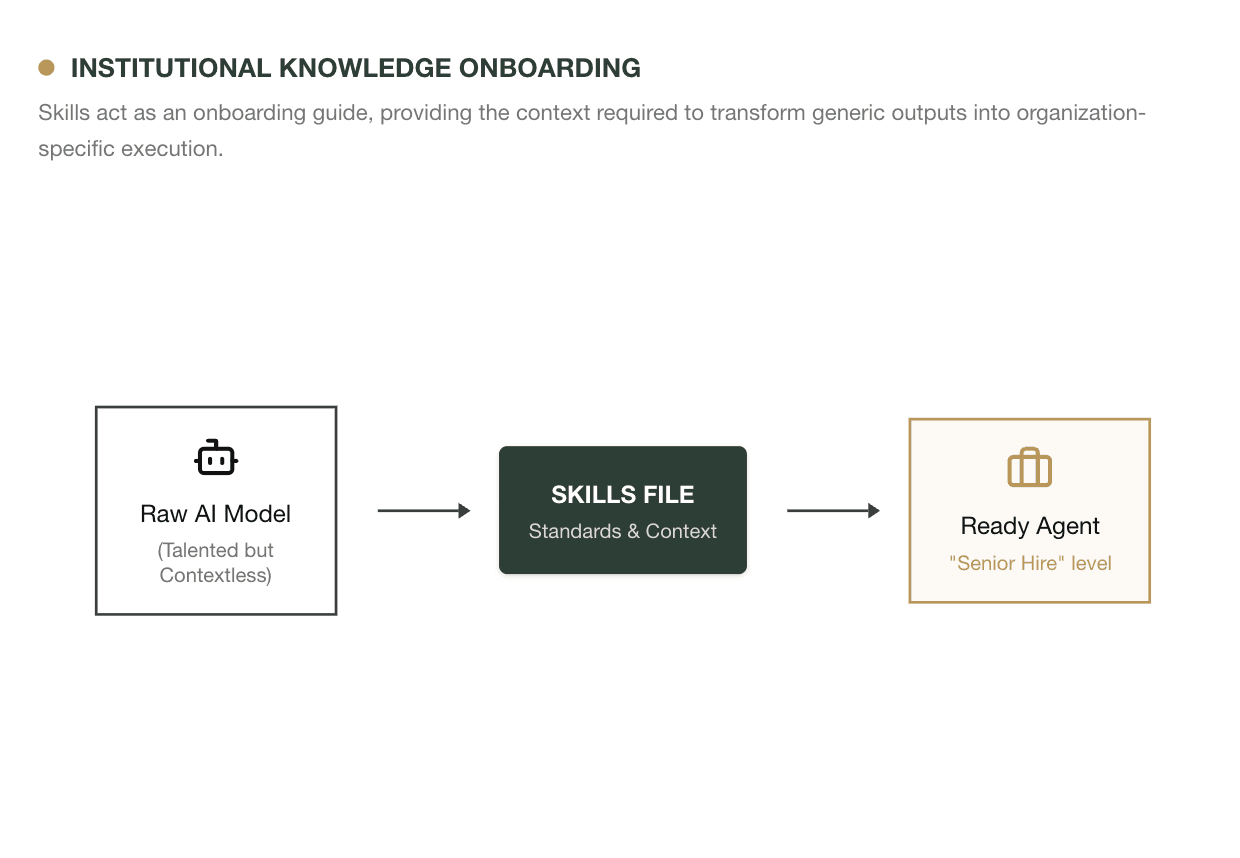
Think of Claude Skills as onboarding guides for AI agents. Anthropic uses precisely that analogy. When you bring a new senior hire into a complex organisation, they may be technically excellent — but they still need context. They need to understand how your business works, what standards matter, what formats you use, and how decisions get made. Without that context, even the most capable person produces generic work.
AI has the same problem. Left to its own devices, it produces capable but contextless output. Skills solve that. They are structured files — essentially organised instruction sets — that tell an AI agent how to approach a specific type of task, tailored to your organisation's own standards, formats, and requirements.
The result is AI that does not just answer questions well. It executes tasks the way your organisation actually needs them done — consistently, to a defined standard, every time.
How They Work in Practice
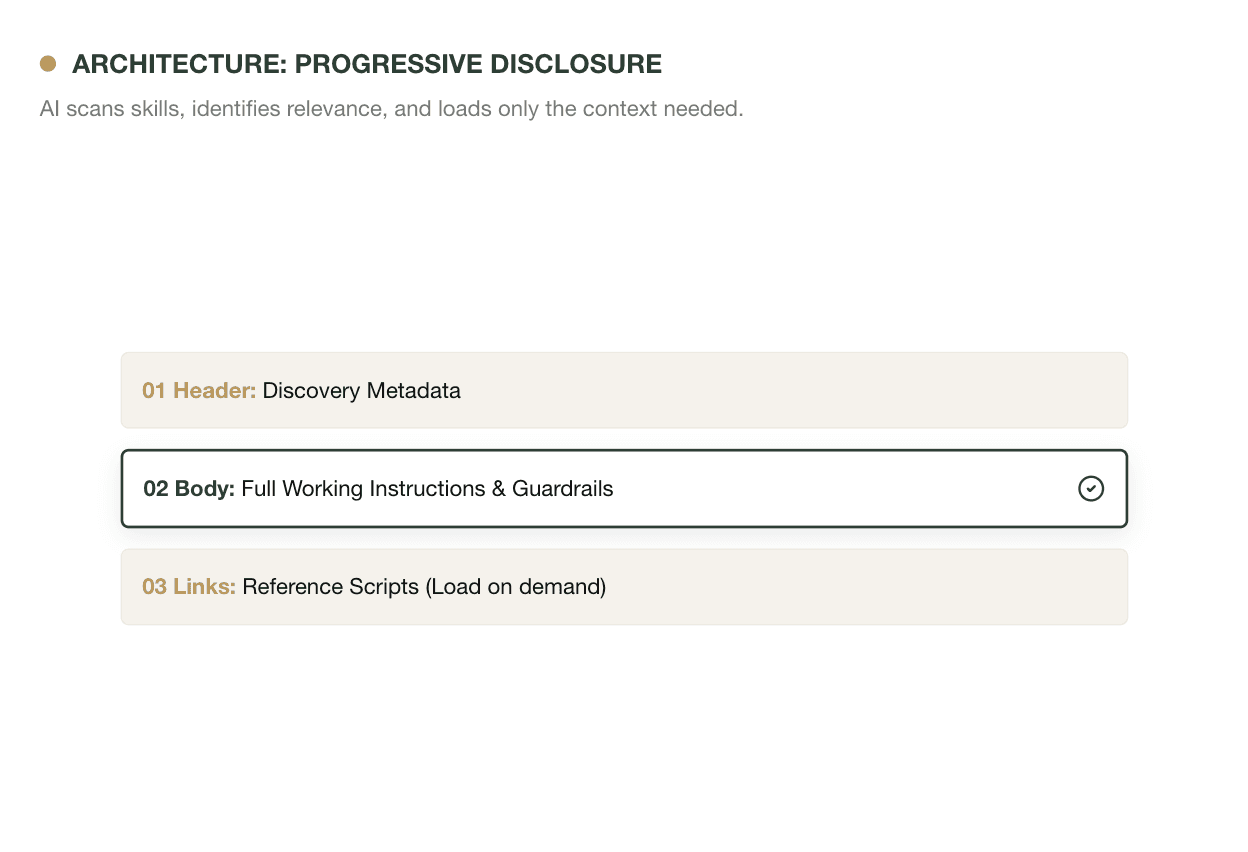
When you give Claude a task, it scans its available Skills, identifies the relevant one, and loads it into the working context for that session. Crucially, it only loads what it needs — an architectural choice that keeps the system efficient and prevents the context window from being overwhelmed with irrelevant instructions.
Each Skill contains three layers of information. A brief header tells the AI what the Skill is for, so it can decide whether it is relevant. A detailed body provides the full working instructions — formats, standards, workflows, quality requirements. And where additional scripts or reference files are needed, these are linked separately and only loaded on demand. The whole structure is designed around what engineers call progressive disclosure: the AI pulls in only the information it needs, precisely when it needs it.
This is not a minor refinement. It is the difference between an AI that broadly understands how to do something and one that knows exactly how your organisation does it.
What This Means for Executive Teams
The practical applications are significant, and they are already working in production environments.
Consider financial reporting. A Skills-enabled agent does not just generate a spreadsheet — it generates one that follows your organisation's specific conventions: your colour-coding standards, your formula architecture, your formatting rules, your preferred chart types. Zero errors. No manual cleanup. The output is boardroom-ready from the first draft.
Consider strategy presentations. Rather than producing a generic slide deck, a Skills-equipped agent can be given your brand guidelines, your narrative conventions, and your preferred structure — and produce a ten-slide stakeholder update that looks and reads like it came from your own team.
Consider product development. Notion recently released a Skill that converts a product specification directly into a structured implementation plan — complete with individual tasks, acceptance criteria, and progress tracking — and pushes the whole thing into a live project management database. What used to take a team several days of translation work between strategy and execution now takes minutes.
One demonstration produced a backlog of 42 user stories, complete with detailed requirements and acceptance criteria, from a single specification document in under ten minutes.
The Difference Between Skills and Everything Else
It is worth being precise about what Skills are and are not, because the AI tooling landscape is currently cluttered with overlapping terminology.
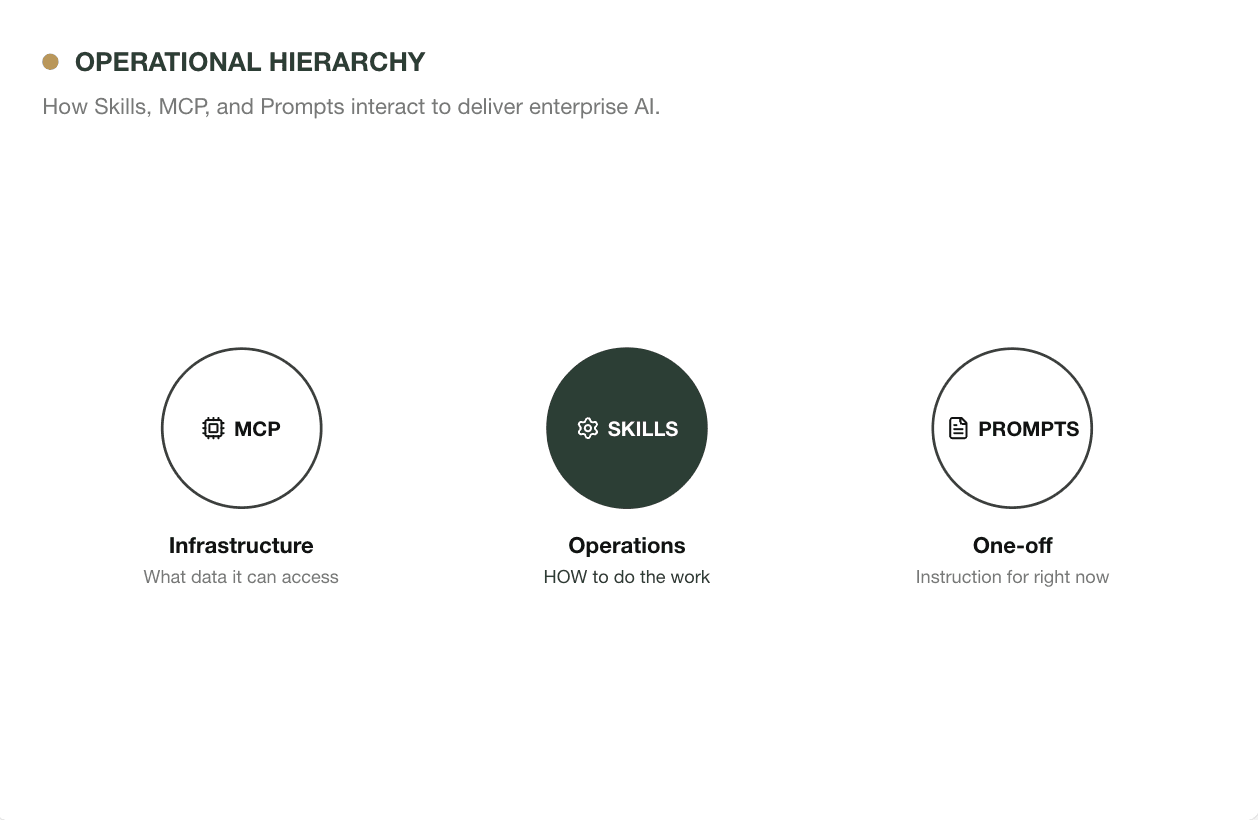
Skills are not the same as MCP — the open protocol that connects AI models to external tools and data sources. MCP is infrastructure. It determines what an AI can access. Skills are operational. They determine how an AI performs a task once it has access to the right information. The two work alongside each other, and the most powerful setups combine both.
Skills are also not the same as prompts. A prompt tells an AI what to do in a single interaction. A Skill encodes how to do a category of work, repeatedly, to a defined standard, across any number of future interactions. It is the difference between a one-time instruction and a reusable capability.
Built-In and Custom
Claude ships with a set of pre-built Skills covering common output types: PowerPoint presentations, Excel spreadsheets, Word documents, and PDFs. These activate automatically when relevant and require no configuration. For most standard business outputs, they represent an immediate upgrade to output quality with no additional setup.
The more interesting opportunity is custom Skills — instruction sets built around your organisation's specific needs. Your brand guidelines. Your financial modelling conventions. Your board reporting format. Your preferred narrative structure for investor communications. Once encoded into a Skill, these standards become permanently available to any AI agent working on your behalf.
Third-party platforms are beginning to release their own Skills as well. Notion, Figma, Atlassian, and Canva all now appear in Anthropic's official Skills directory. The ecosystem is expanding quickly, which means the range of tasks that can be executed to a defined, repeatable standard is expanding with it.
A Workflow Worth Trying: The Board Pack
Here is a concrete example of how a leadership team might use Claude Skills today, with no technical setup required.
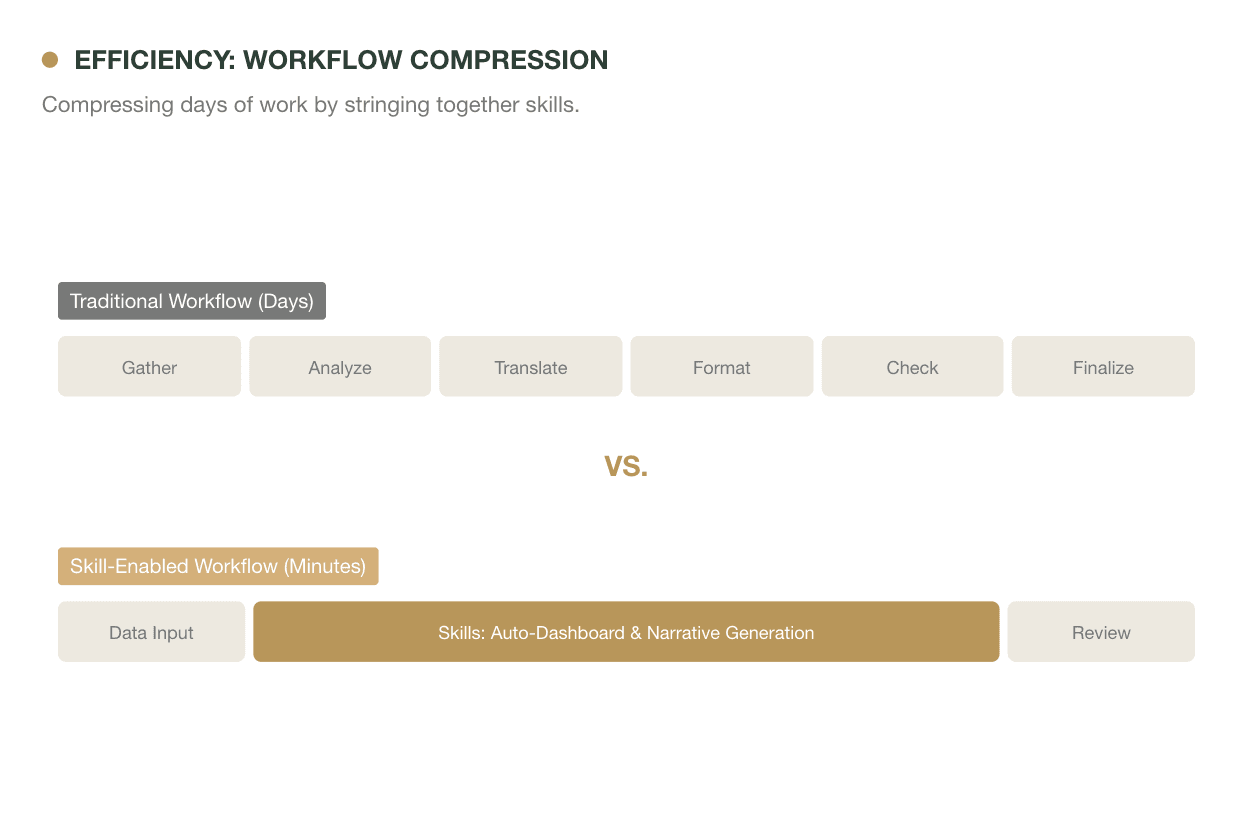
Most executives running a quarterly board pack go through the same sequence. Raw data comes in from finance. Someone translates it into slides. Someone else checks the narrative holds together. A third person formats everything to company standard. The whole process takes days and involves more people than it should.
With Claude Skills, that workflow compresses significantly. Start by uploading your financial data — a revenue summary, a pipeline report, whatever feeds the pack — and ask Claude to build a performance dashboard. The pre-built Excel Skill activates automatically, applying correct formula logic, zero errors, and clean formatting without being asked.
From there, ask Claude to turn that data into a board presentation. Give it your brand guidelines as a custom Skill — your colours, your fonts, your preferred slide structure — and it will produce a draft deck that follows your organisation's visual standards, not a generic AI template.
Finally, ask it to write the executive narrative: the two-page summary that contextualises the numbers for board members who want interpretation, not just data. Point it to any relevant prior board communications and it will match your house tone.
The whole sequence — data to dashboard to deck to narrative — takes under an hour. The outputs are not perfect first drafts in every case, but they are serious working documents that would previously have required a full day of skilled team time to produce. The review and refinement still sits with you. The assembly does not.
That is the practical value of Skills for executive teams. Not replacing judgment. Removing the work that sits between a decision and a document.
The Strategic Implication
The most important shift here is not about speed, though Skills do make AI significantly faster at producing usable output. It is about reliability.
Until now, the core limitation of AI in senior professional contexts has been consistency. You could get a brilliant output one day and a mediocre one the next, with no reliable way to ensure the former. Skills change that calculus. They make AI output predictable — not in the sense of being formulaic, but in the sense of consistently meeting a defined standard.
For executive teams, that changes the risk calculation around AI delegation. When the output of an AI agent is as predictable as the output of a well-briefed team member, the range of tasks you can confidently hand off expands considerably.
The organisations that move earliest to encode their institutional standards into reusable AI Skills will have a compounding advantage. Every task the AI completes draws on accumulated organisational knowledge. Every output it produces reinforces a consistent standard. The gap between those organisations and those still treating AI as a one-off prompt tool will widen quickly.
Skills are not a feature update. They are the beginning of AI that genuinely operates at an institutional level.
Further reading
What Are Skills? — Anthropic Help Centre The clearest plain-language explanation of how Skills work, who they are available to, and how they differ from prompts, Projects, and MCP. A good starting point before going deeper.
Agent Skills Overview — Anthropic API Docs The full technical overview of how Agent Skills are structured, what pre-built Skills are available, and how custom Skills can be deployed across Claude's products.
Skill Authoring Best Practices — Anthropic API Docs How to write Skills that work reliably — covering naming, descriptions, progressive disclosure, and the common mistakes that cause Skills to underperform.
Anthropic Skills Repository — GitHub The public repository of Skills built and maintained by Anthropic, covering document creation, enterprise communications, branding, and more. Useful as a reference for what well-structured Skills look like in practice.