Tom Blomfield just gave one of the most useful talks about AI and company-building in recent memory. It deserves more attention than it has got.
Blomfield is a General Partner at Y Combinator, co-founder of Monzo, and someone who has spent the last two years watching hundreds of early-stage companies work out what AI actually means for how they build. The talk, delivered to a recent YC batch, is not about AI tools or productivity hacks. It is about whether the fundamental unit of business organisation still makes sense.
The answer, he argues, is that it does not.
The Roman legion problem
Blomfield opens with an analogy that lands hard. Roman legions were engineered to project power from a single centre across two continents — nested hierarchies, consistent spans of control, named individuals passing orders down and information up. It was a remarkably durable system. It worked brilliantly for Rome.
Most companies today are organised exactly the same way. A CEO at the centre, layers of management below, human beings acting as the conduit for information flowing up and down the hierarchy. Strategy moves down through the layers. Data and problems move back up. Coordination is the job of the people in between.
His argument is that AI breaks this model. Not incrementally. Structurally. The reason hierarchies exist at all is to solve a coordination and communication problem — and that is precisely the problem AI is now best positioned to solve. When the underlying reason for an organisational structure disappears, the structure itself becomes a liability.
Why the copilot framing misses the point
The productivity framing of AI — it makes engineers 20% faster, copilots slot into existing workflows, teams ship more software — is seductive because it requires no rethinking. Keep the legion. Give it better weapons. The org chart stays intact and the board presentation writes itself.
Blomfield is direct about this. It is the old way of working with a more powerful engine bolted on. You are taking an existing structure and adding a faster engine rather than asking whether the structure was ever the right one.
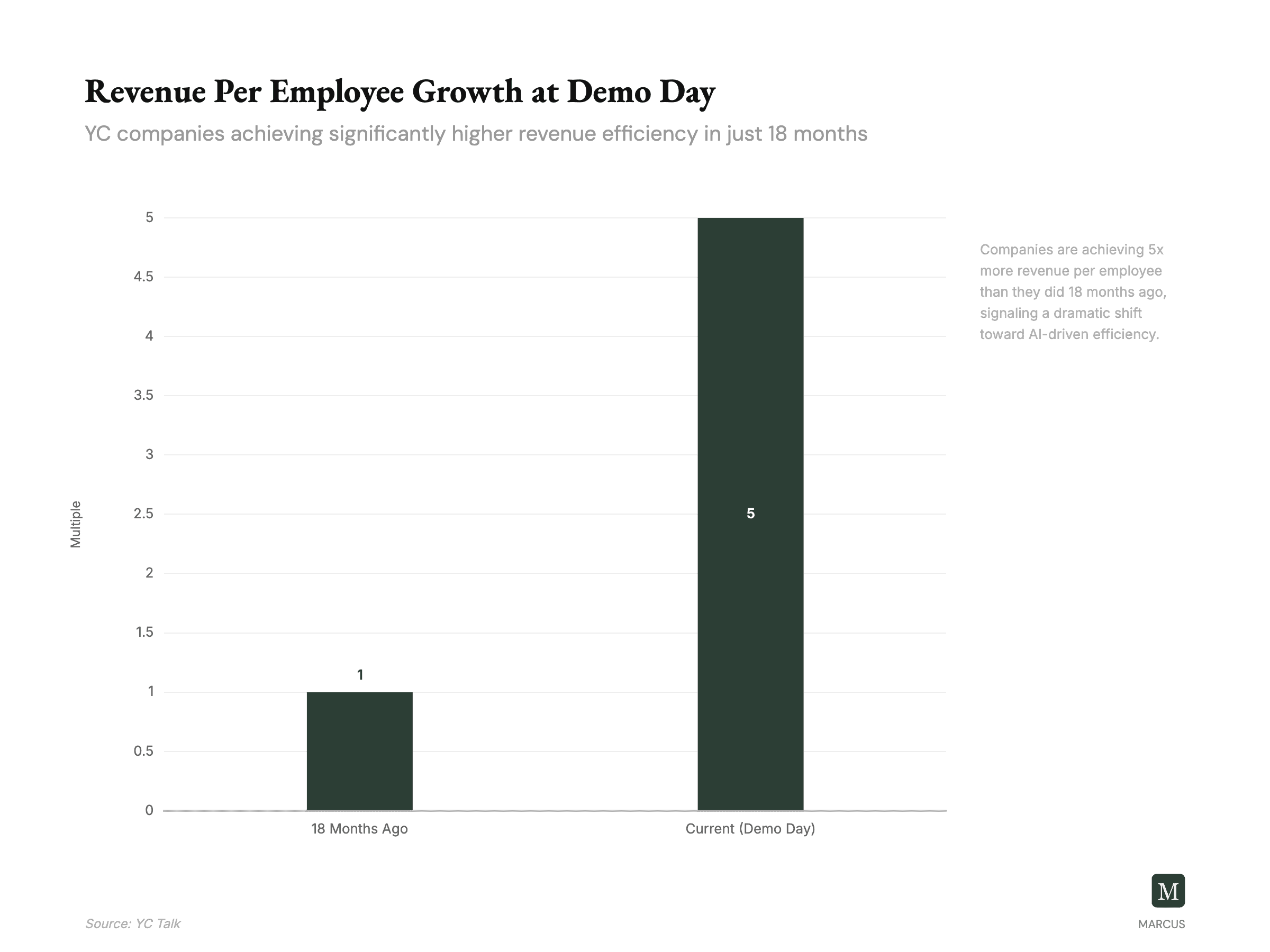
The more interesting question is not how AI makes the current organisation more efficient, but whether the organisation needs to exist in its current form at all. One engineer today, with the right setup and the right context, can produce more output than an entire engineering team. That is not a productivity story. That is a structural one — and most leadership teams have not yet internalised what it means.
The loop that changes everything
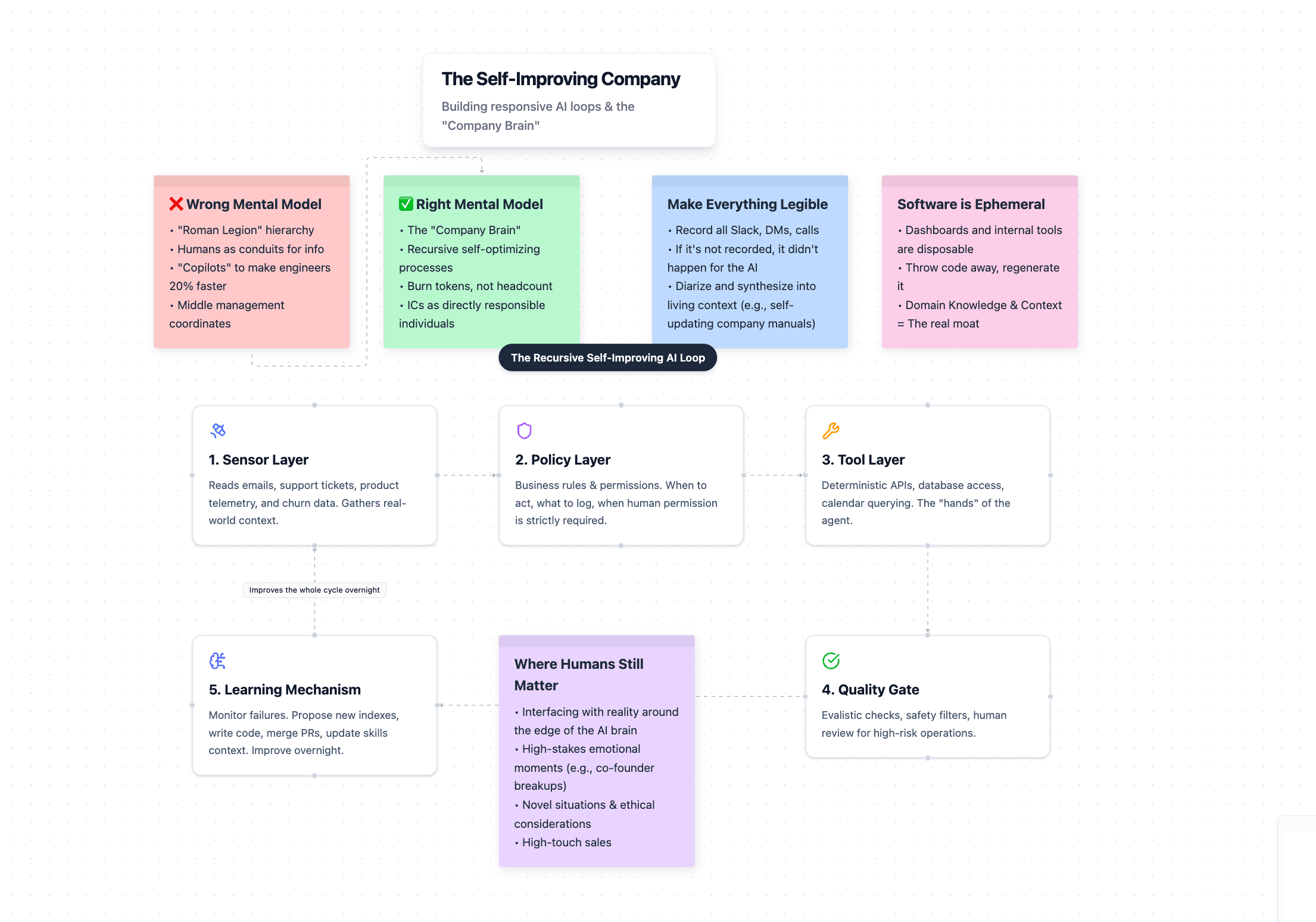
The concept at the centre of the talk is what Blomfield calls a recursive self-improving AI loop. It has five layers working in sequence.
A sensor layer pulls in data from the outside world — customer emails, support tickets, product telemetry, cancellation signals, anything that carries information about how the business is actually performing. A policy layer defines what the system can do autonomously and what requires human review or sign-off. A tool layer provides deterministic APIs the AI can call — query the database, check the calendar, look up a customer record. A quality gate handles safety filters and human review for high-stakes decisions. And a learning mechanism feeds outcomes back into the top of the loop.
The key question is whether every step of that loop can run with minimal human intervention. If it can, the system compounds in capability without requiring anyone to actively drive it forward. It gets better while no one is watching.
The example Blomfield gives to make this concrete is the moment the talk shifts from conceptual to genuinely striking. YC built a monitoring agent that watches every query made by every employee, identifies where the AI system failed to return a useful answer, works out what would have made it succeed — whether that means new tools, updated skills, a different database view, a new index — then writes the code to fix it, submits a pull request, has a second agent review and merge it, and deploys. Overnight. By the time the same person asks the same question the following morning, the system has already corrected itself.
No human involvement. No ticket raised. No meeting to discuss it. The system identified its own failure, diagnosed the cause, wrote the fix, and shipped it.
Blomfield describes this as his genuine "holy shit" moment with AI — and it is not hard to see why. This is not a productivity gain measurable in percentage points. It is a qualitatively different kind of system. One that improves through use rather than requiring active maintenance.
Three implications for senior leaders
Blomfield draws out several practical implications worth sitting with seriously.
The first is making the organisation legible to AI. If something is not recorded, it did not happen — as far as any AI system is concerned. The institutional knowledge currently locked inside people's heads, buried in email threads, scattered across Slack and documents and informal conversations, only becomes an organisational asset when it is captured and structured.
His example: YC has been recording office hours for the last few months, accumulating roughly 2,000 hours of conversations between partners and founders. A partner took those recordings over a weekend, structured them by topic, and used them to regenerate the YC user manual — a document that had been largely static for five to ten years. The result was a 150-page document, dramatically more current and comprehensive than the original, which can now be updated monthly as new conversations are recorded. The manual becomes a living representation of the organisation's actual thinking rather than a historical artefact.
The same principle applies to any business. Every customer conversation, every strategic discussion, every decision and the reasoning behind it — if it is captured, it becomes part of the organisation's intelligence. If it is not captured, it exists only in the heads of the people involved, and it leaves when they do.
The second implication is treating software as ephemeral and context as the real asset. The domain knowledge, the captured decisions, the understanding of how the business actually operates — that is durable. The software built on top of it can be generated, used, discarded, and regenerated as models improve. Store the context preciously. Treat the code as disposable. The valuable part is the comprehension of how the function works, not the software that currently executes it.
The third implication is the one most likely to cause discomfort in a leadership context: the coordination function of middle management is probably finished as a distinct organisational role. The problem middle management primarily solves is passing information up and filtering decisions down — precisely what AI does well, faster, and without the distortion that inevitably happens when humans act as information conduits. What remains is individual contributors with clear ownership of specific outcomes, and senior leaders making the judgement calls the system is not equipped to make.
Blomfield is not suggesting companies need no management structure. He is suggesting that the layer of people whose primary function is coordination and information flow is a cost that no longer buys what it used to.
Where humans still fit
None of this removes people from the picture. It concentrates them where models cannot yet reach.
Novel situations that fall outside the system's training. High-stakes emotional conversations where the relationship itself is the outcome. Ethical calls that require genuine human judgement and accountability. The moments where a founder is considering breaking up with their co-founder, or a leadership team is navigating a situation that has no precedent in the data. Complex enterprise sales conversations where trust is built over time and the deal lives or dies on human credibility.
Blomfield's framing is elegant: humans sit at the edge of the system, at the points where intelligence makes contact with reality. The AI handles coordination, synthesis, pattern recognition, and continuous improvement. The humans handle the moments where those capabilities are not sufficient.
The question worth sitting with
Blomfield closes with a single question directed at the founders in the room. If you were building your company today, from scratch, would you build it as a Roman legion?
For most organisations, the honest answer is no. The founders and senior leaders who get this right will run companies that compound in capability without compounding in headcount — systems that improve through use, that capture institutional knowledge rather than losing it to attrition, that fix their own failures overnight rather than waiting for a quarterly review to surface them.
The window to build this by design rather than being forced into it by circumstance is open. The organisations small enough to rebuild are the lucky ones. For larger businesses, the same principles apply but the path is harder — not because the technology is unavailable, but because the Roman legion has been running for a long time and the people inside it have built careers around it.
The self-improving company is not a futurist concept. It is being built right now, by a small number of teams who have stopped asking how AI can make their current structure more efficient and started asking what structure actually makes sense.