Most executives are using AI. Far fewer are using it in a way that actually compounds.
The distinction matters. When AI use is individual and ad hoc — each person prompting their own way, figuring things out independently, starting from scratch every session — the organisation gets marginal productivity gains. When AI use is systematic and institutional, the organisation gets smarter as a unit. That's a different category of advantage.
Ramp, the fintech company, recently published a detailed account of how they built their internal AI infrastructure. It's one of the clearest real-world examples of what institutional AI use actually looks like in practice. Here's what senior leaders can take from it.
Start by solving the adoption problem, not the capability problem
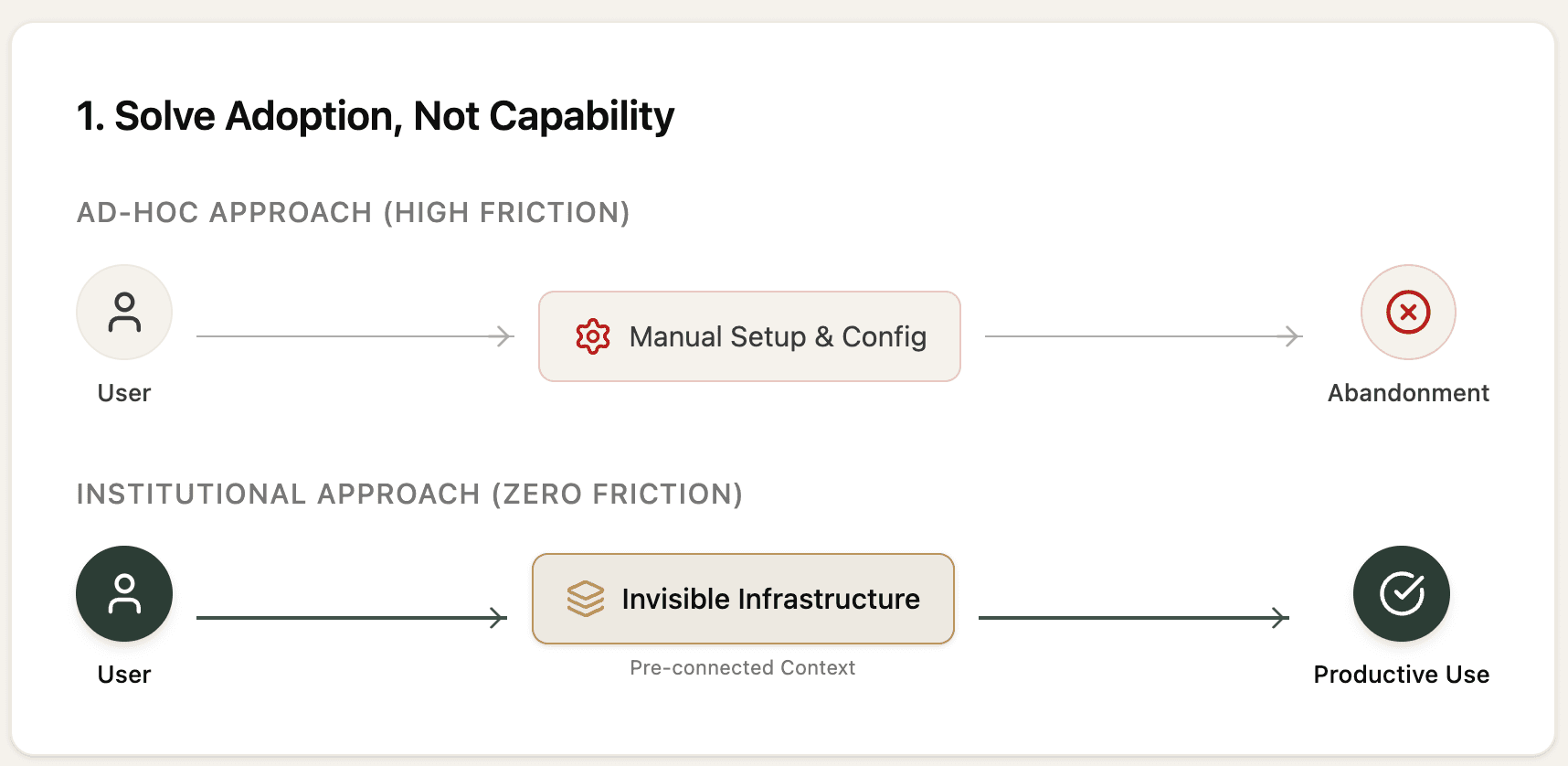
The most common failure mode in enterprise AI rollouts isn't that the tools aren't powerful enough. It's that getting to productive use requires too much individual effort. People sign up, experiment, get inconsistent results, and quietly revert to their old workflows.
Ramp found the same thing. Initial adoption of AI tools was high; sustained, productive use was not. Their response was to remove all configuration friction at the point of entry. Employees sign in once, everything they need is already connected — their calendar, their CRM, their Slack channels, their code repositories. There's nothing to set up.
Most organisations can't build that from scratch, but the principle applies at every level. If you want AI to be genuinely used, the path to productive use has to be shorter than the path of least resistance. That means making the setup invisible, the starting point contextualised, and the early outputs good enough to create a habit.
Treat expertise as infrastructure
This is the most important strategic insight from Ramp's approach, and the one most organisations are missing entirely.
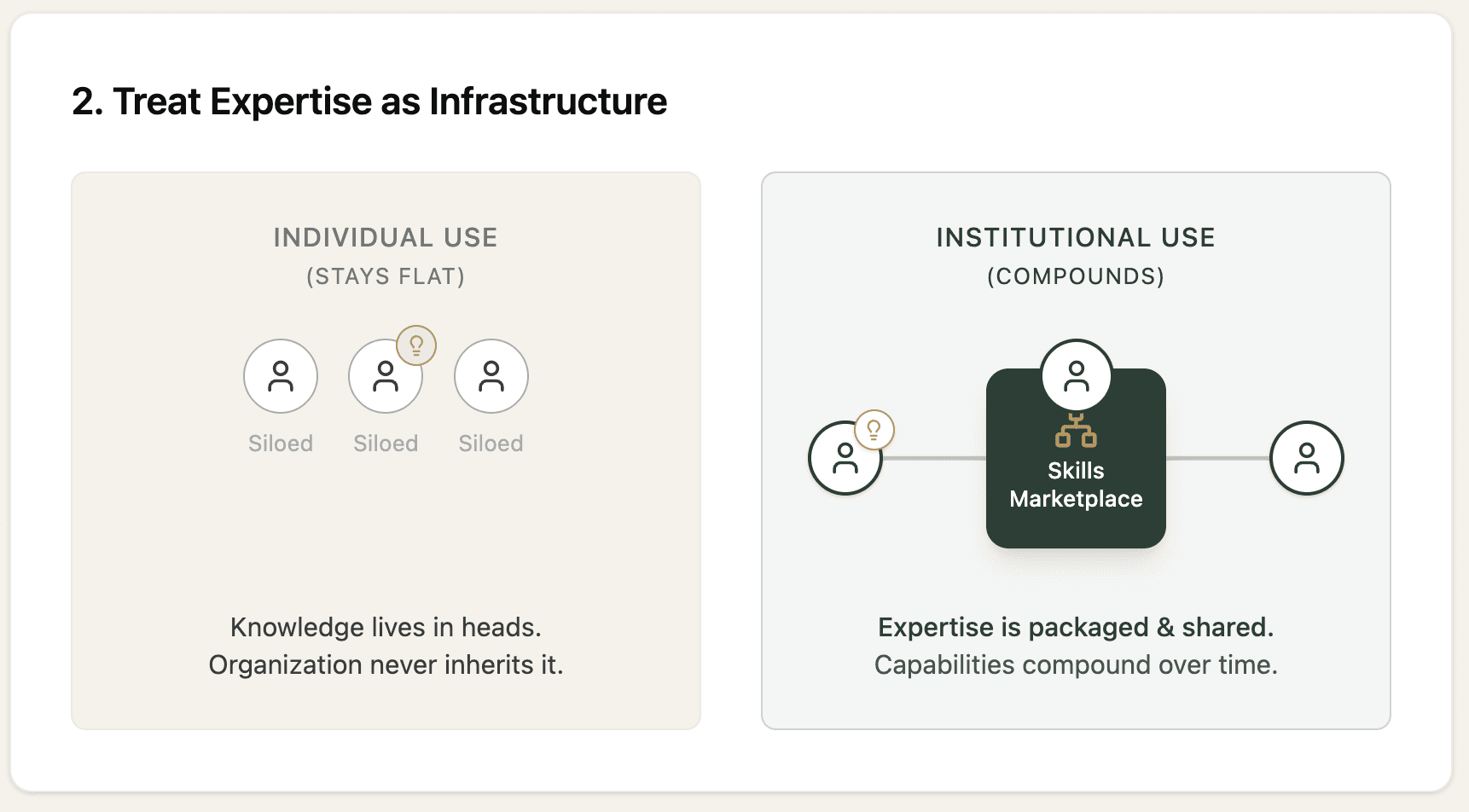
In most companies, when someone figures out a better way to do something — a more rigorous approach to a competitive analysis, a better structure for synthesising customer feedback, a sharper way to evaluate a vendor — that knowledge lives in their head. It might get passed to the person next to them. It disappears when they change roles. The organisation never inherits it.
Ramp built a skills marketplace called Dojo where employees package their best AI workflows into reusable, executable instruction sets. Over 350 of these now circulate across the company. When a sales rep figures out the best way to analyse a call and draft a competitive battlecard, every other rep inherits that capability immediately.
The strategic implication is significant. An organisation where expertise is packaged and shared compounds its capabilities over time. One where expertise stays in individual heads stays flat. The gap between those two trajectories, sustained over two or three years, becomes structural.
The question worth asking your team: when one of your best people develops a genuinely better approach to an important task, where does that knowledge go?
Build memory into how AI is used, not just how it's accessed
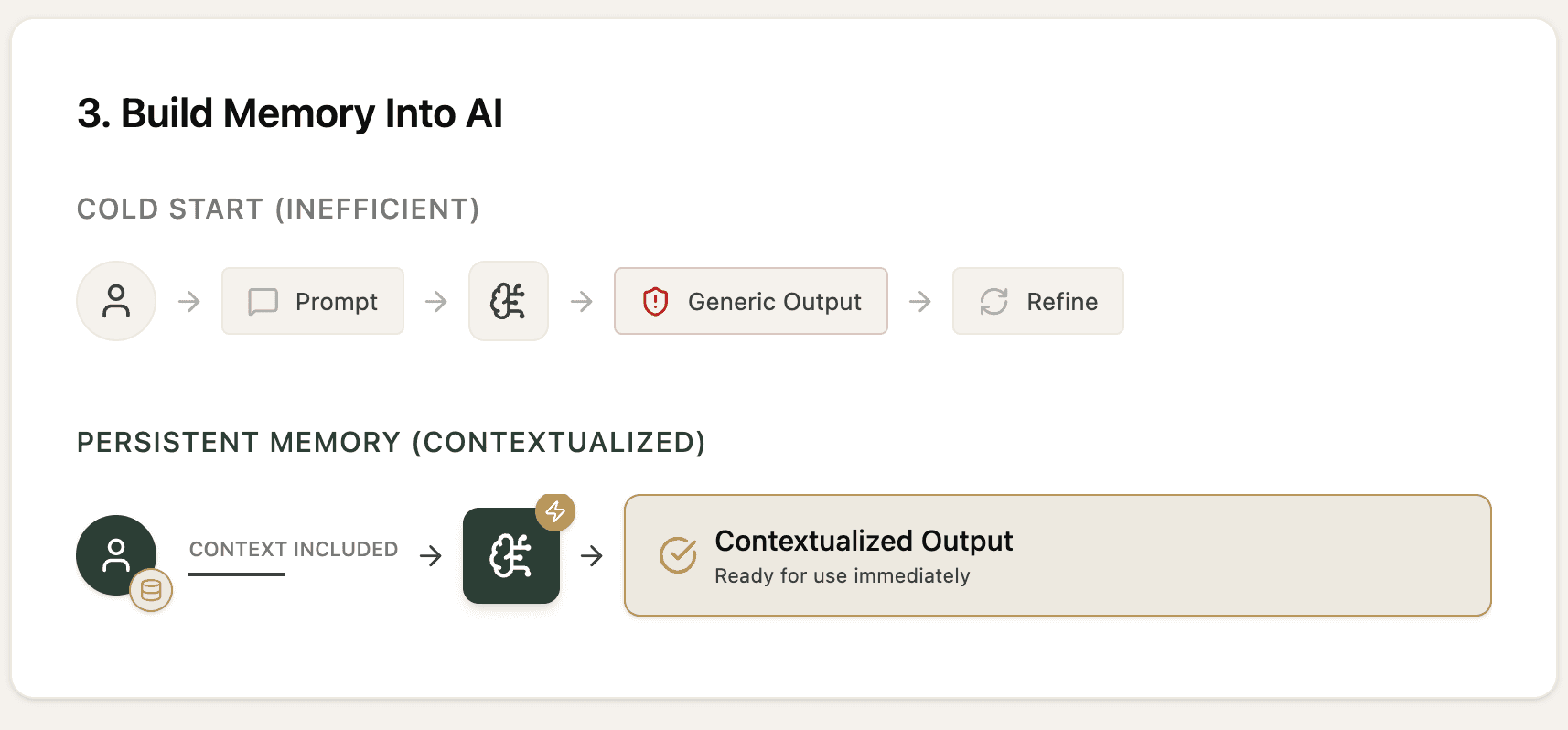
Most AI sessions start cold. You open the tool, re-explain your context, get a generic response, refine it, and eventually get to something useful. This is enormously inefficient, and it's one of the main reasons people underestimate what AI can actually do.
Ramp's Glass builds a persistent memory profile from the first session — active projects, key relationships, recent decisions, relevant documents. Before anyone types a message, the agent has a working model of who they are and what they're working on.
You don't need to build proprietary infrastructure to get the benefit of this. What you do need is a discipline around how sessions are initiated. The leaders who get consistently strong outputs from AI tools are the ones who treat context as the first input, not an afterthought. They brief the AI the way they'd brief a senior advisor: here's the situation, here's what I know, here's what I'm trying to decide.
This is a behaviour change more than a technology change. But it produces meaningfully different results.
Make AI work scheduled, not just reactive
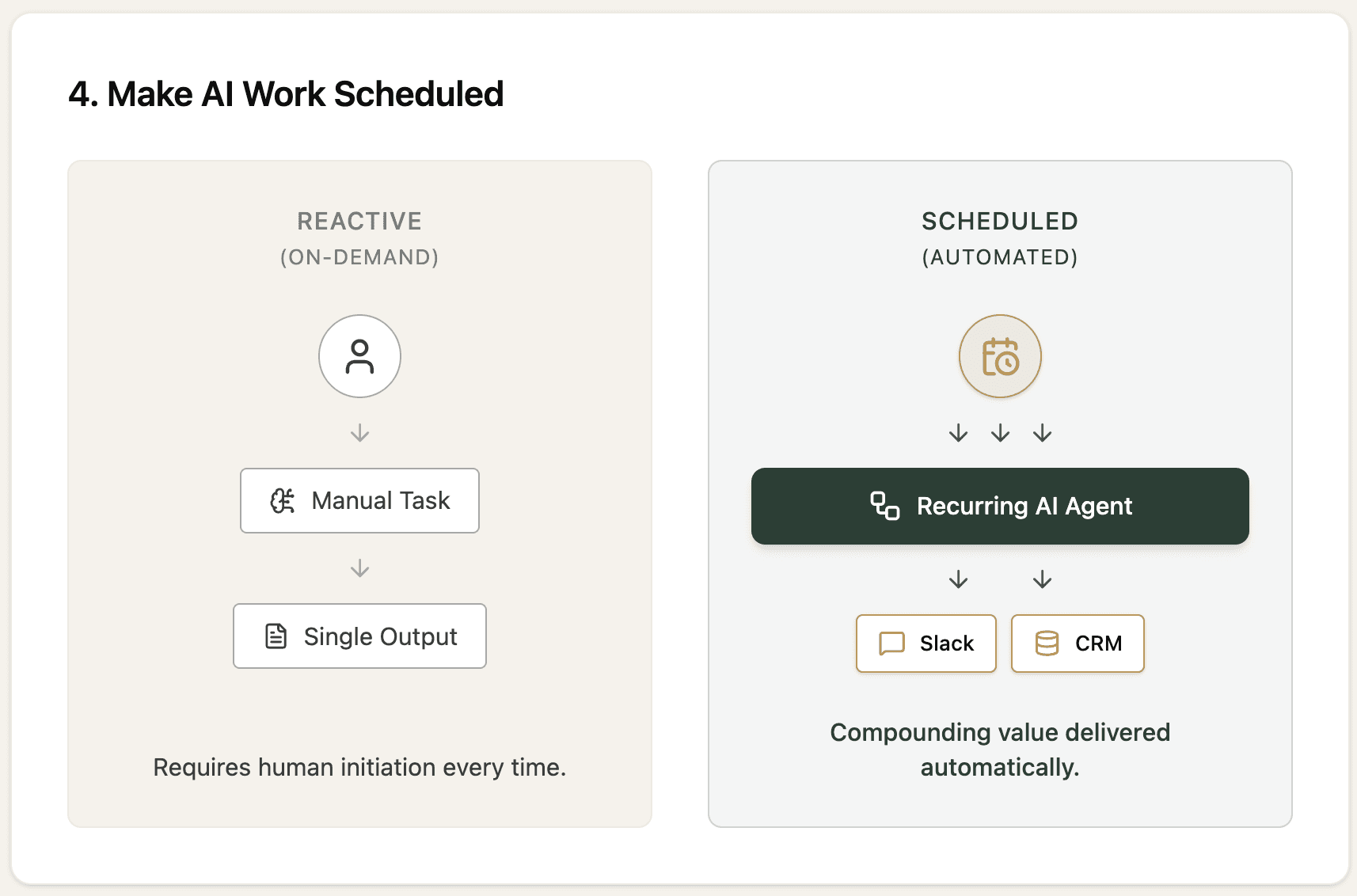
One of the highest-leverage things Ramp built was the ability to schedule automations — recurring AI-powered tasks that run on a daily or weekly cadence and deliver results directly into the channels where decisions get made.
A finance lead sets up a morning digest of spend anomalies. A product team gets a weekly summary of NPS movement and open bugs. A city operations manager receives a supply-demand report every Monday before standup. Each of these was set up once. The compounding value of a useful output delivered every week indefinitely is categorically different from the value of any individual session.
The practical question for your organisation: what information do your teams currently assemble manually on a recurring basis that AI could produce automatically? And what decisions are being made without that information because assembling it is too slow?
Use AI maturity as a hiring and positioning signal
Ramp is explicit that building Glass wasn't just an internal productivity exercise. It's a signal — to candidates, to customers, to the market — that they are an AI-native organisation.
Several of the most AI-progressive companies are now hiring dedicated internal AI specialists: people whose job is to build and maintain the internal infrastructure that makes everyone else faster. This is an emerging role, and the companies creating it are betting that internal AI capability will become a visible differentiator.
Whether or not you hire for this role, the underlying point holds. How your organisation uses AI internally will increasingly be legible externally — in how fast you move, in the quality of what you produce, in how your people talk about their work. That reputation compounds too.
The practical starting point
If you want to move from individual AI use to institutional AI use, there are four things worth doing now.
First, audit where your best people are using AI effectively and package those approaches for the rest of the organisation. Don't let that knowledge stay informal.
Second, establish a standard for how AI sessions should be initiated — what context should always be included, what the expected output looks like, what good use actually means in your context.
Third, identify three to five recurring analytical or communications tasks that AI could handle on a schedule rather than on demand. Start there before trying to boil the ocean.
Fourth, treat AI fluency as a leadership capability, not just an operational one. The executives who understand what's now possible — not at a surface level, but well enough to ask the right questions and make genuine resource decisions — will have a significant advantage over those who delegate the topic entirely.
The compounding returns go to organisations that start building the habit now, not the ones with the most sophisticated tools.