Every year, Stanford's Institute for Human-Centered AI publishes its AI Index. It's the most comprehensive, independently sourced analysis of where AI actually stands — not where the press releases say it stands.
The 2026 edition covers 400+ pages of data across capability, investment, governance, labour markets, and public opinion. What follows are the findings that belong in your strategic planning, your board conversations, and your risk frameworks.
The adoption debate is over
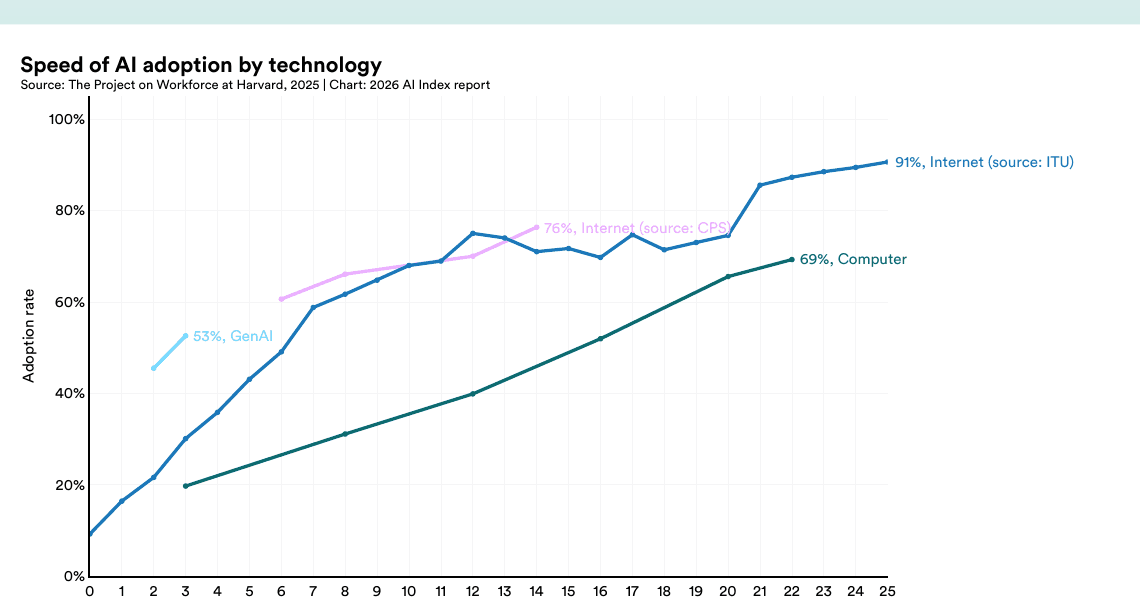
Start with the number that settles it: generative AI reached 53% population-level adoption within three years. The PC took a decade. The internet took longer. This is the fastest mass adoption of a general-purpose technology in recorded history.
At the organisational level, the numbers are equally stark: 88% of companies now report using AI in some capacity. Four in five university students use generative AI for academic work. The estimated consumer value of generative AI in the U.S. alone is $172 billion annually. Median value per user tripled between 2025 and 2026.
Any organisation still framing AI adoption as a competitive differentiator — something that sets it apart from peers — is working from an outdated map. The differentiation now lives entirely in how well the technology is deployed, governed, and converted into value.
Capability is accelerating, not plateauing
There has been persistent commentary that AI improvement is slowing. The data says otherwise.
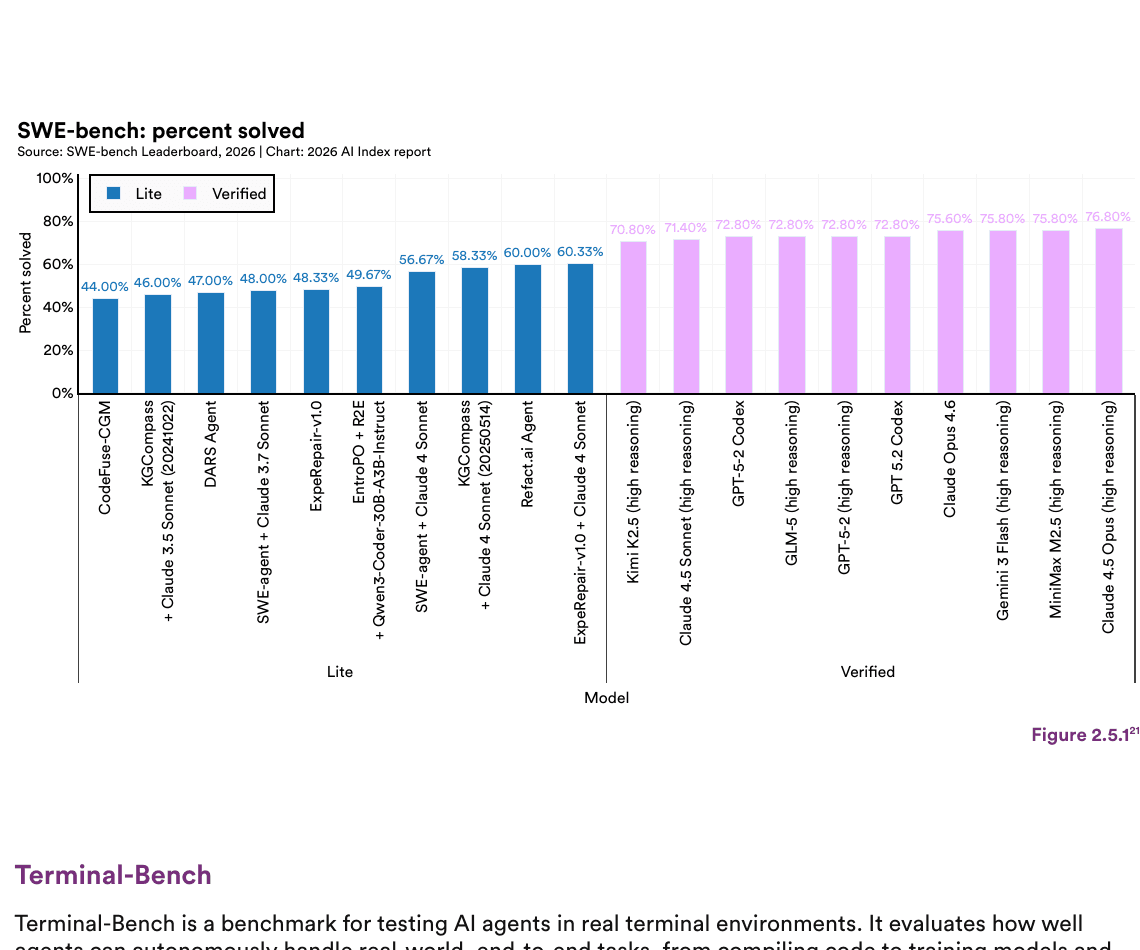
On SWE-bench Verified — a benchmark measuring AI performance on real-world software engineering tasks — scores rose from 60% to near 100% of the human baseline in a single year. Leading models now meet human performance on PhD-level science questions, multimodal reasoning, and competition mathematics. Gemini Deep Think won a gold medal at the International Mathematical Olympiad in 2025.
AI agents — systems that execute sequences of actions autonomously — jumped from 12% to approximately 66% task success on OSWorld, which tests agents across real computer operating environments.
The practical consequence: assumptions about AI's limitations need to be revisited roughly every six months. Constraints that were real eighteen months ago may no longer apply. That review cadence belongs in the planning cycle.
The geopolitical shift most leaders are underestimating
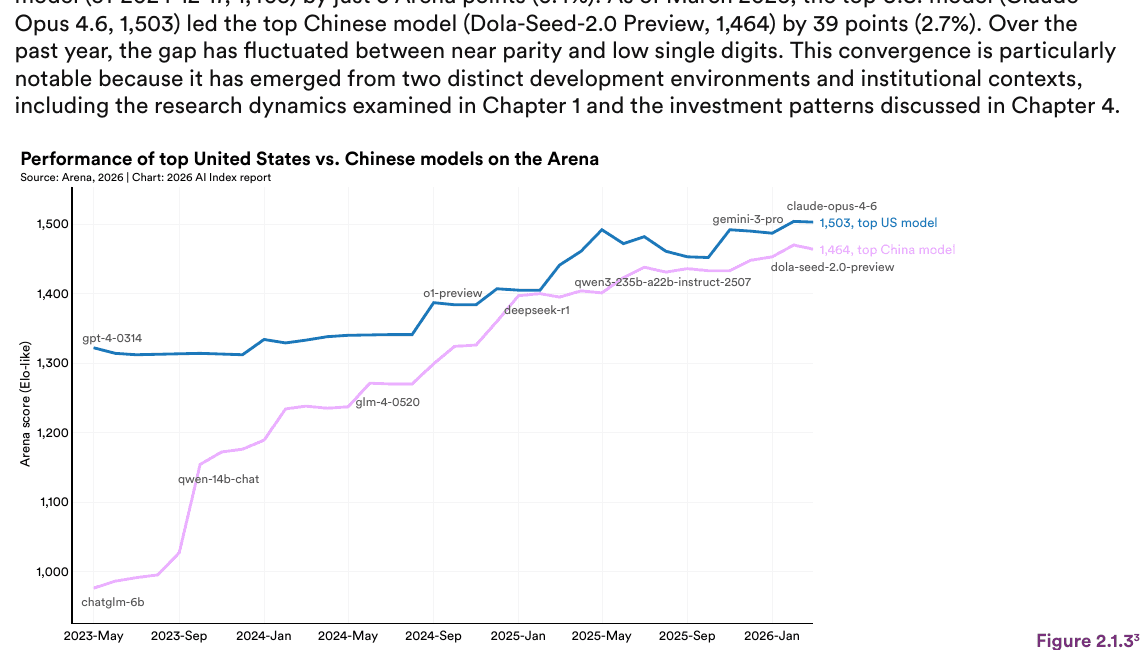
One of the most board-relevant findings in the report: the U.S.-China AI performance gap has effectively closed.
The two countries have traded the performance lead multiple times since early 2025. As of March 2026, the top U.S. model leads China's best by just 2.7%. China leads in publication volume, citations, total patent output, and industrial robot installations. The U.S. leads in top-tier model production and higher-impact patents. South Korea leads the world in AI patents per capita.
The supply chain finding deserves particular attention. The United States hosts 5,427 data centres — more than ten times any other country — but almost every leading AI chip inside them is fabricated by a single company: TSMC, in Taiwan. The entire global AI infrastructure supply chain runs through one foundry on one island.
That concentration belongs on every board risk agenda. Vendor diversification strategies, technology partnership structures, and supply chain exposure all look different once this dependency is properly understood.
The productivity data is real — and uneven
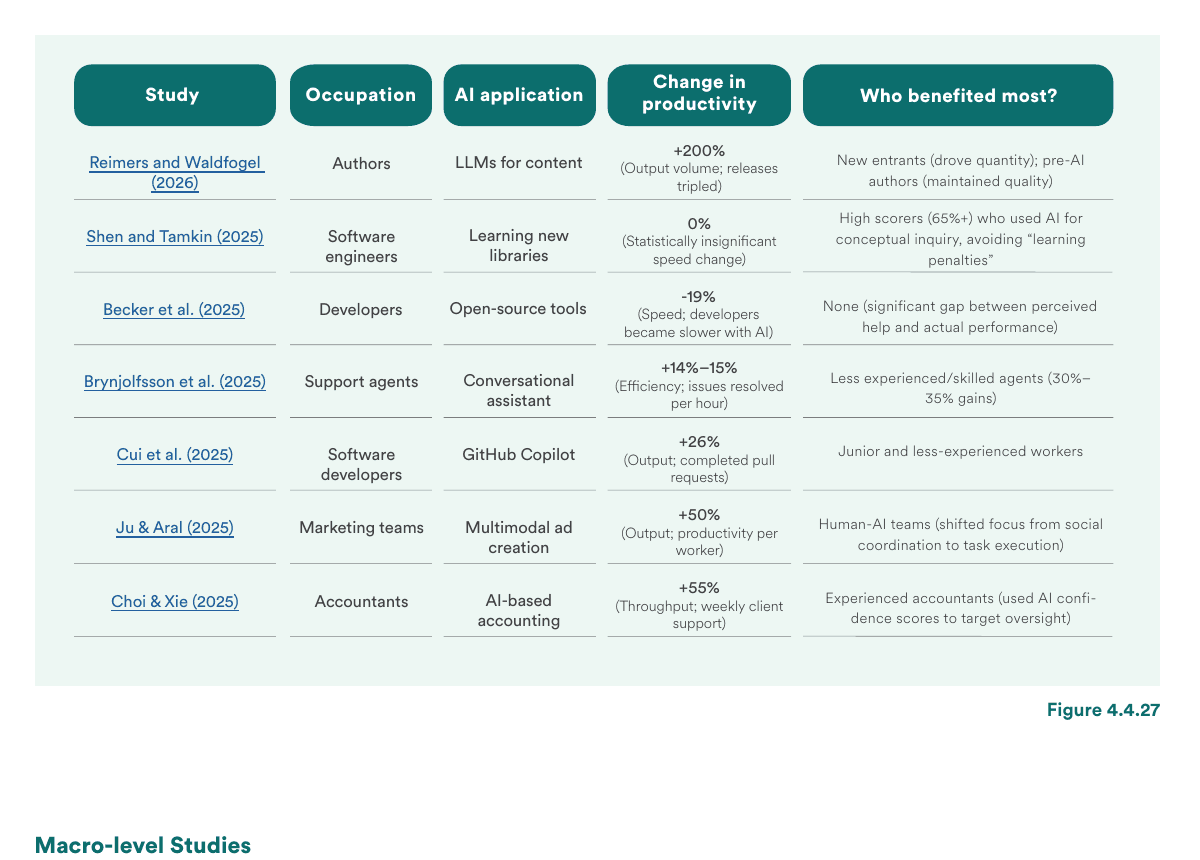
Studies documented in the 2026 report show productivity gains of 14% to 26% in customer support and software development. Measured outcomes from live deployments, not projections.
But the distribution of those gains matters as much as the headline numbers. Gains are strongest in structured, repeatable, high-volume tasks. They weaken — and in some cases turn negative — in tasks requiring significant judgment or contextual complexity. AI agent deployment remains in single digits across nearly all business functions outside of technology.
The labour market data attached to these numbers warrants attention. In software development — where AI's productivity gains are most clearly measured — U.S. developers aged 22 to 25 saw employment fall nearly 20% from 2024, even as headcount for more senior developers continued to grow. The pattern emerging across the data: AI is compressing entry-level roles in the exact functions where its value is most demonstrable. The medium-term consequence is a thinner bench of experienced practitioners in those areas — an organisational risk that most workforce planning models do not yet account for.
The jagged frontier problem
The 2026 report gives useful language to something many leaders have encountered directly: the jagged frontier. AI capability is deeply uneven in ways that are difficult to anticipate before deployment.
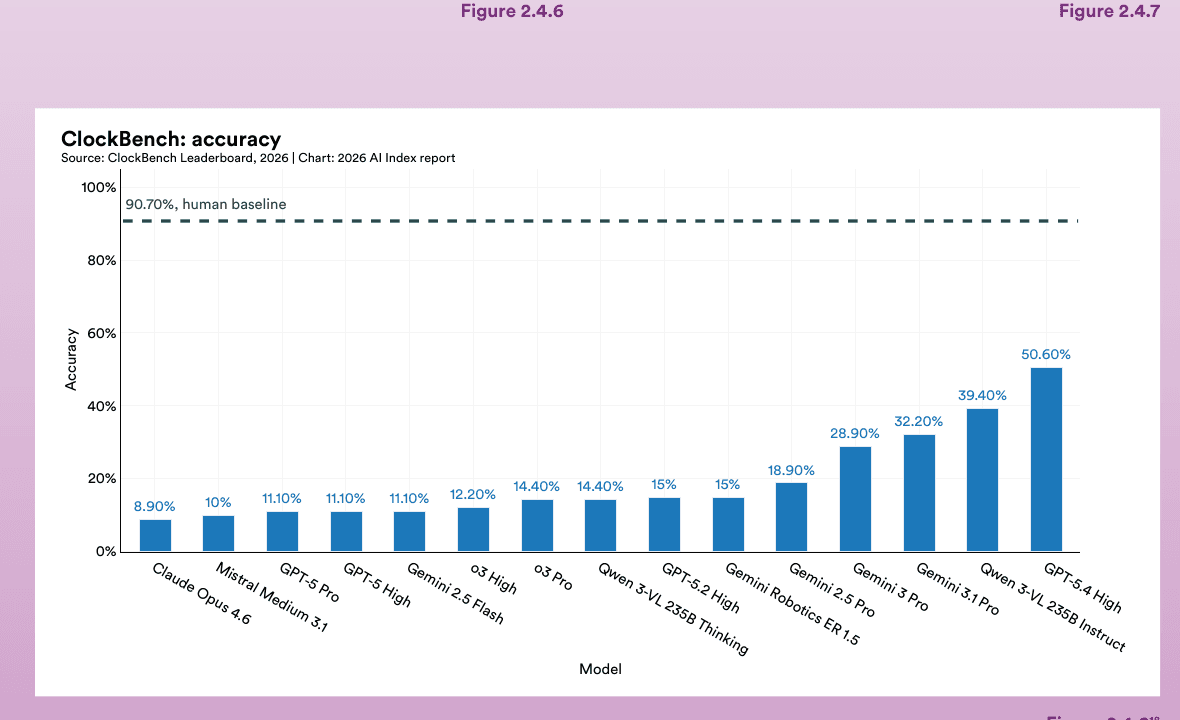
The same model that wins a gold medal at the International Mathematical Olympiad reads an analogue clock correctly just 50.1% of the time. AI systems that outperform human chemists on ChemBench score below 20% on astrophysics replication tasks. Robots achieve 89.4% success in controlled software simulations but succeed in only 12% of actual household tasks.
General capability claims are not a sound basis for deployment decisions. A system that performs exceptionally well on a benchmark may fail on the adjacent task the business needs it to perform. Every deployment requires empirical testing against the specific use case. Vendor benchmarks are not a substitute for operational validation.
The governance gap
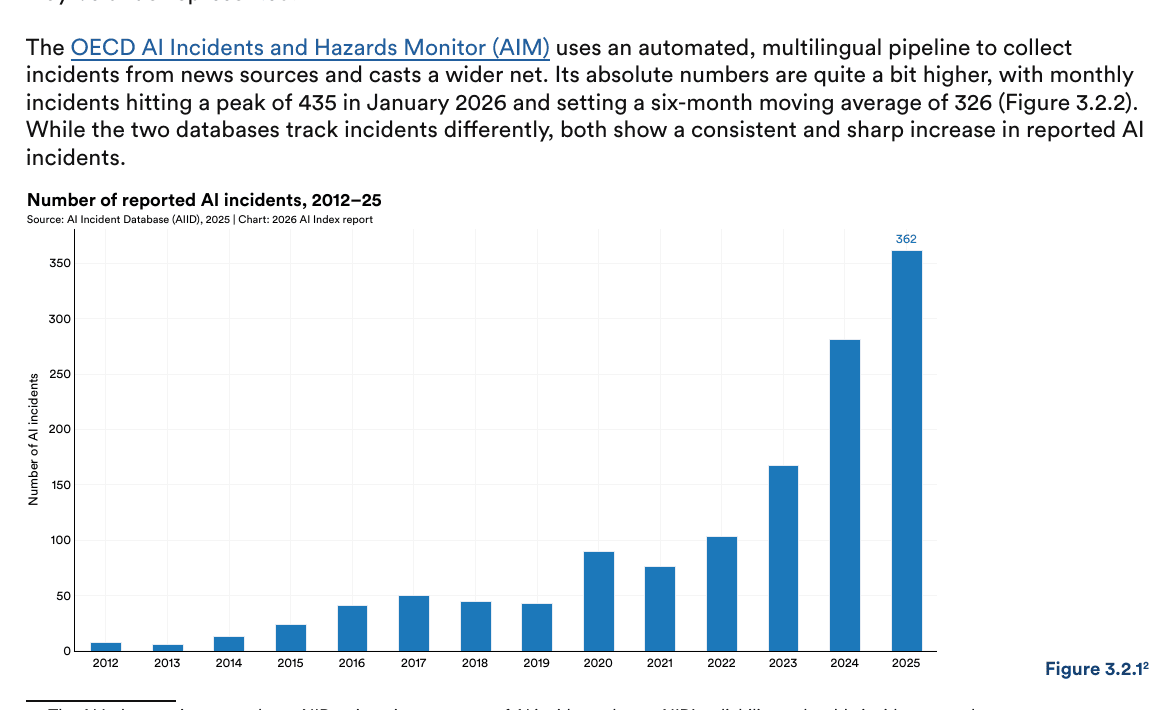
Documented AI incidents rose to 362 in 2025, up from 233 in 2024. Almost all frontier AI developers report results on capability benchmarks — but reporting on responsible AI benchmarks is inconsistent and in many cases absent.
The major labs have stopped disclosing parameter counts, training dataset sizes, and training duration for their most capable models. Transparency is declining as capability rises.
The research also found that improving one responsible AI dimension can actively degrade another. Improving safety can reduce accuracy. These trade-offs don't resolve at greater scale.
As AI systems are deployed deeper into operational functions — customer-facing decisions, hiring workflows, financial products, clinical environments — the liability exposure from inadequately governed AI grows correspondingly. Governance frameworks that don't yet exist should not be assumed to be a future problem.
The talent warning
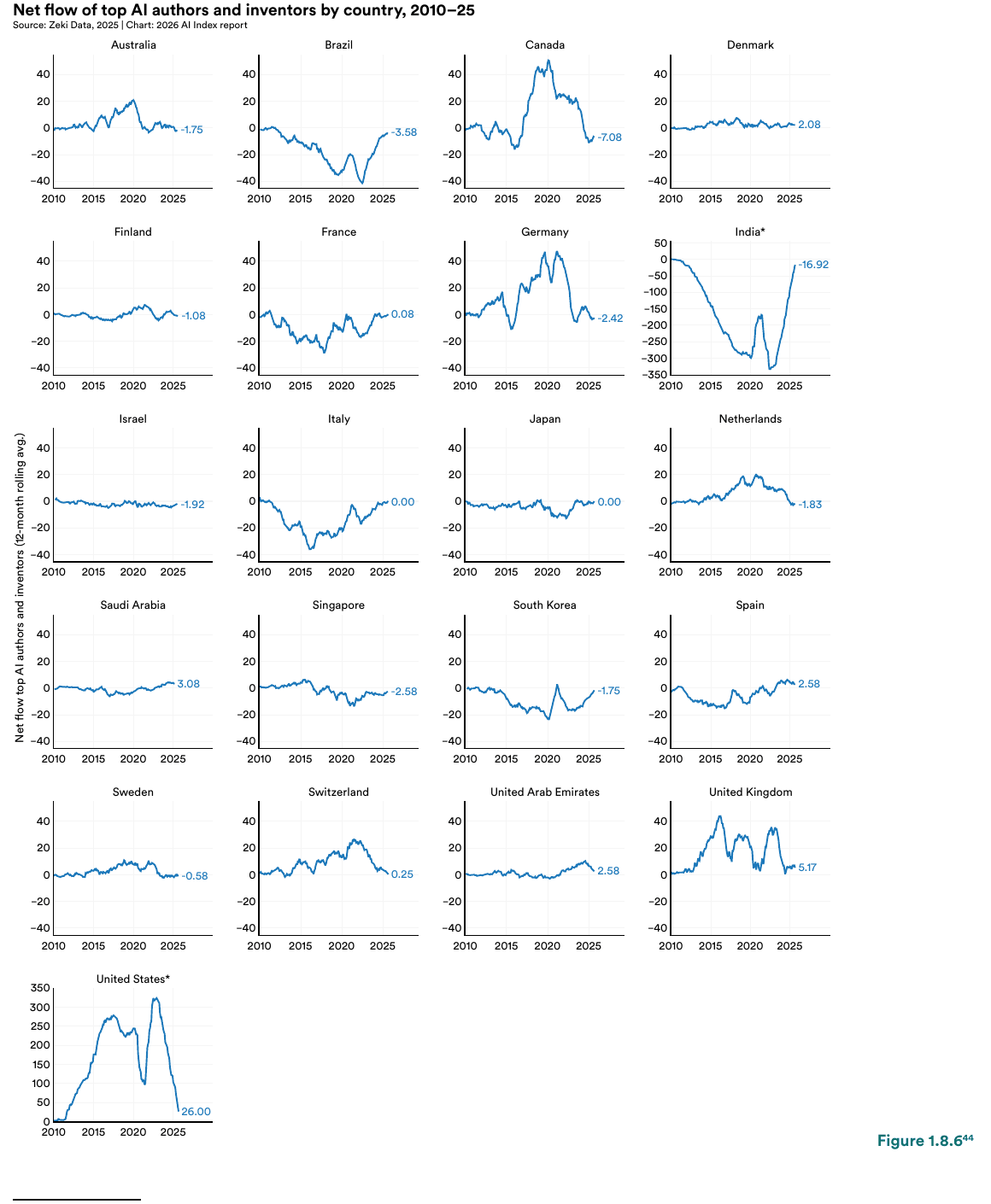
The number of AI researchers and developers relocating to the United States has dropped 89% since 2017 — falling 80% in the last twelve months alone. The U.S. still hosts more AI talent than any other country. But it is attracting new talent at the lowest rate in over a decade.
For any organisation competing for technical capability, this has direct implications for hiring strategy, retention investment, and the build-versus-buy calculus on AI capability.
The gap that defines the next decade
The 2026 AI Index doesn't offer strategic recommendations. It presents data. And the data shows a consistent pattern across every chapter: AI capability is advancing faster than the organisational, regulatory, and governance systems designed to manage it.
The organisations that lead over the next five years will be the ones that close that gap — through governance structures, deployment discipline, and the kind of senior leadership attention that turns capability into durable advantage.